Showing posts with label Hymnody. Show all posts

The Holy Martyrs Timothy and Maura

In preparing the Synaxarion readings for today, I was particularly moved and inspired by this so thought I would share:

On this day, the 3rd of May, Holy Church commemorates the Martyrs Timothy and Maura. The father of Timothy was the village priest in a settlement near Antinoe in the Thebaid and brought up his son in Christian piety.

Timothy, from his first years as a youth, served during his father's term in the rank of reader and the keeper of liturgical books. St Timothy read sacred books daily at home. But he read them with special inspiration in church assemblies on Saturdays and Sundays. For his distinct, intelligent, and reverent reading during the divine services St Timothy was respected by Christians. Another obligation of his rank as reader, Timothy considered the writing of sacred books. For Timothy, the writing of sacred books was not only an obligation but also was a hobby. He called the copied books his children, his expensive treasure that he also shared with the Christians of his church community.

Having married a 17 year old maiden, Maura, who came from a prosperous family, he found in her who also had a distinguished Christian education a friend for life, capable of empathising with his moods. She respected the calling of her husband and she empathised with him, inspiring him with what he read in the sacred books in the church. She also liked to read sacred books,

Piety, Processions, and Puppetry
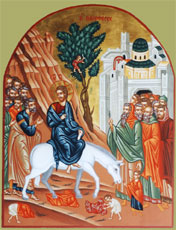
This post is really just a string of ideas rather than a planned construction of coherent thoughts and I claim no authority beyond being a servant of Christ's Church who often fails miserably at his calling to be even that. Yet a conversation I recently had with a priest, shortly after witnessing the services of Holy Week and Pascha, got me to thinking a little about the liturgy of the Church and how, through it, we enter into the worship of God.

I love the multi-layered symbolism of the corporate worship of the Church. When we begin to explore it, there is so much that gives us the firm grounding from which to elevate our hearts to God. It is doctrine expressed and acted out, often in the most accessible way possible. Processions, prostrations, crossings, the opening and closing of the doors - some of these things speak to us immediately and have an obvious meaning. Yet some of them have depths of meaning that only come to us with time and being steeped in the Church's worship. For instance, at the old Paschal Vigil which we serve on Holy Saturday afternoon in the form of the Vesperal Liturgy of St Basil, we hear the reading from Isaiah, (the same one that provides the inspiration for the oft-repeated hymn, Shine, shine, O New Jerusalem), in which we hear:

And thy gates shall be open continually: they shall not be shut day nor night.

- Isaiah 60:11

So the doors of the iconostas remain open through Bright Week, and are not closed until the beginning of the Ninth Hour on Saturday of that week, for this is the week of thr renewal, when we celebrate most fully the conqeuring of all that separates us from the fullness of union with God.

However, I wonder at the nature of some of the things that have crept into Orthodox practice and the degree to which they are in keeping with the Tradition of the Church. One of the most powerful symbols of Great and Holy Friday is at Matins. After the fifth Gospel, which ends with Christ taking up his Cross and being assisted by Simon of Cyrene, during the fifteenth antiphon, the priest solemnly carries the large icon of the Saviour on the Cross from the altar and sets it in the midst of the church for the edificaton of the people. This becomes their focus as they hear the remaining Passion Gospels, which tell of the final events in the Passion of the Saviour, including his death. After the service, the people may come forward and venerate the icon, kissing the feet of their Saviour on the Cross.

Today is hung upon a Tree He Who suspended the earth upon the waters.
He who is King of the Angels is arrayed in a crown of thorns.
He who wrapped the heaven in clouds is wrapped in the purple of mockery,

He who freed Adam in the Jordan receiveth a blow on the face.

The Bridegroom of the Church is transfixed with nails.

The Son of the Virgin is pierced with a lance.

We worship thy Passion, O Christ,
We worship thy Passion, O Christ: show unto us also thy glorious Resurrection!
- The fifteenth antiphon of Great Friday Matins

Yet a custom has developed in some places of setting up a plain Cross in the midst of the Church before the service begins, and the icon that is carried out at the fifteenth antiphon is of the corpus only. This often has holes pre-drilled in the hands and feet, through which nails are inserted, and the priest hammers the icon to the Cross during the service.

I have never seen this done in full so I cannot comment on it experientially. However, it seems to run contrary to everything that I have been taught about the place of icons in the doctrine and praxis of the Orthodox Church. Icons serve to focus the mind and heart on the holy one represented in the image.

For by so much more frequently as they are seen in artistic representation, by so much more readily are men lifted up to the memory of their prototypes, and to a longing after them; and to these should be given due salutation and honourable reverence (ἀσπασμὸν καὶ τιμητικὴν προσκύνησιν), not indeed that true worship of faith (λατρείαν) which pertains alone to the divine nature; but to these, as to the figure of the precious and life-giving Cross and to the Book of the Gospels and to the other holy objects, incense and lights may be offered according to ancient pious custom. For the honour which is paid to the image passes on to that which the image represents, and he who reveres the image reveres in it the subject represented. For thus the teaching of our holy Fathers, that is the tradition of the Catholic Church, which from one end of the earth to the other hath received the Gospel, is strengthened. Thus we follow Paul, who spake in Christ, and the whole divine Apostolic company and the holy Fathers, holding fast the traditions which we have received. So we sing prophetically the triumphal hymns of the Church, “Rejoice greatly, O daughter of Sion; Shout, O daughter of Jerusalem. Rejoice and be glad with all thy heart. The Lord hath taken away from thee the oppression of thine adversaries; thou art redeemed from the hand of thine enemies. The Lord is a King in the midst of thee; thou shalt not see evil any more, and peace be unto thee for ever."
- from the decree of the Seventh Ecumenical Council

With that in mind, the traditional practice of placing the icon of the crucified Saviour in the midst of the people and their later veneration of it seems very fitting. However, I, personally, struggle with the idea of an icon being used as, if I may be forgiven, a theatre prop. I'm just not sure that this action of nailing an image of the Saviour to the Cross is in keeping with the Orthodox theology of the icon and I am not sure it is something that should be encouraged. If the honour paid to the icon is passed to the holy person represented therein, what are we doing when we hammer nails into an icon of the Saviour? In the quiet piety of Orthodox Christians, an icon, if accidentally knocked over, is often picked up quickly and kissed before being returned to its place of honour, because people understand what the image represents, even if the Saint is largely unknown. Yet we are speaking here about pounding nails into an icon of the Christ.

Even if we leave aside the matter of the nailing, I do not like the concept of the detachable corpus being placed on the Cross, and then taken down during the Vespers service and wrapped in a shroud to be taken into the altar, (which is the second half of this late practice). For the same reasons as the nailing, it seems not to sit well with the concept of the icon as an object of focus and veneration. My priestly interlocutor said to me that the Orthodox understanding of the icon does not extend to puppetry. It may seem a shocking statement to make at first but, having given it some thought, I find myself unable to disagree.

The Church's services have a drama of their own, in their shape and structure, in the way one element flows into another, which then overlaps with the next, in the readings, in the hymns, in the actions of the clergy and people - all of these things carry beautiful meaning and symbolism, and speak of the mystery of salvation into which we are to enter more fully through these services. If we think, for example, of the traditional Great Friday ceremonies, they are actually very restrained while being very rich. When we focus on the Passion of the Saviour at Matins, the Cross is set up in the midst of the people and censed. Before Vespers, the Cross is quietly removed because the focus of this service is not the Passion but rather the burial of the Saviour. There is no theatrical taking down of the icon of the Saviour's body from the Cross and wrapping it in a burial shroud. Where the Cross once stood, we now see the sepulchre of the Lord, on which is placed the plashchanitsa, which is an icon showing the body of the Saviour, often surrounded by his Mother and the Holy Myrrh-Bearers. It is carried out solemnly, and offered for veneration by the people. Offerings of flora and rose water are laid on it in honour of the Christ depicted. Then, during the Midnight Office of the Paschal Vigil, the plashchanitsa is removed from the midst of the people with the same solemnity with which it was placed there, and when the people go outside for the procession after the Midnight Office, the sepulchre is quietly removed, so that when the people re-enter the church, it is simply not there, having been replaced by an icon of the Resurrection.

So it seems to me that the mystical drama into which we are to be caught up is inherent to the services themselves and is not to be found in extraneous re-enactments of Christ being crucified, taken down from the Cross, or wrapped in a shroud.

Another historical example of this is the procession of Palm Sunday. A very late development in parts of the west in Orthodox times, possibly originating in France, was the custom of including the Holy Things in the procession on Palm Sunday. This was different from the custom known among Roman Catholic people today, of carrying the sacrament in procession as a sign of devotion. As it came to develop in Britain by the late mediaeval period, an elaborate portable shrine was constructed, on which would be carried the Holy Things. As this approached, the choir would sing antiphons hailing the coming Christ, reminiscent of the Hebrews greeting the Saviour with shouts and hymns as He entered Jerusalem, which would continue through the procession. This was not simply a devotion to Christ in the Mystery of the Eucharist, (although the extra-eucharistic piety, including such processions, is perhaps intrinsically questionable anyway), but rather seems to have been a theatrical re-enactment over and above the natural drama of the Church's liturgy, using the sacrament in a very unusual way.

How did this sort of thing creep into Orthodox custom? These things do not appear in the rubrics of the services but are simply pious additions which are largely unknown outside of Greek practice, so I wonder whether these are latinisations, (in terms of the way of thinking about how we worship rather direct borrowings of practice), that permeated the Greek church under Ottoman rule. I recall once reading that a number of Greek clergy during this time were trained in Roman Catholic seminaries. Whatever the origins, is it something that is in keeping with the way that we understand worship, that we feel worship, that we do worship? Is it something that we ought to continue? I don't think so, personally, but my saying so comes largely from gut feeling based on what I have been taught and what I have absorbed, and how it has moulded me over the past few years and is not something that I can argue academically. However, given the centrality of worship to the Christian life and the importance that has in transmitting the Faith to the innermost parts of our beings, I do not feel that the degree to which the way we worship affects our understanding of our own place in relation to Christ and within the life of his Church can be thought of too lightly.

Anyway, there my thoughts are. I don't know what, if anything, others make of them.

Psalm 103 sung to Valaam Chant

Vespers in the Byzantine Rite begins with Psalm 103. It is the psalm of creation, sung at the beginning of the new day, and is all the more loaded with meaning at Saturday Vespers, when we usher in the Sunday, looking forward to the Eighth Day of the New Creation. According to the ustav, (or typikon, for those who like Greek words), the Royal Doors remain open during this psalm while the priest censes the church and people, reminding us of the paradise that was open to our first parents through their communion with God. Immediately afterwards, the doors are closed. A Manual of the Orthodox Church's Divine Services tells us that this is to show that our dwelling in paradise was short-lived, and that we are totally dependent on the mercy of God as we turn to Him in prayer in the Great Litany, with the deacon's words, 'In peace, let us pray to the Lord'.

I love the plethora of settings of Psalm 103, but I have, over the past year, developed a fondness for the music of the Valaam monastery in particular. After Jordanville, it is the place I currently most want to visit. Below is the choir of the Holy Cross Hermitage, (music section here), singing an English translation of Psalm 103 to a Valaam setting. It is in its abbreviated form with refrains, as is permitted when Vespers is served as part of the All-Night Vigil.


I think it's beautiful. I have a recording of the Valaam Monastery choir and the setting of the Phos Hilaron on my CD is very similar. They are more complex than - but remind me of - the Carpatho-Russian music that I love, and some of which we occasionally use at my parish. Perhaps there is a simple setting of the Song of Symeon that we can adopt when we resume Saturday Vespers instead of it simply being intoned.

Lent

O Lord and Master of my life, drive away from me the spirit of despondency, negligence, avarice and idle talk. But grant me, thy servant, the spirit of chastity, humility, patience, and love. Yea, O Lord and King, grant me to see mine own transgressions, and not to judge my brother, for blessed art Thou unto the ages. Amen.
- A Prayer of St Ephraim the Syrian

The great fast is upon us. Of all whom I have hurt, offended, or otherwise wronged, I ask forgiveness.

This calling to once again direct our footsteps towards Christ, and to give particular attention to the expulsion fr
om our lives of those things that hinder that is particularly timely for me this year because of certain recent developments, and certainly well needed after an emotionally and spiritually difficult few months. That is all I feel able to say publicly for now but your prayers would be appreciated.

I was baptised on the Sunday of the Prodigal Son so I always think of the words of the kondak of that Sunday in a very personal way, as applying to my Baptism. (A beautiful rendering of it in Byzantine chant may be heard here). Its actual application to my own life leaves much to be desired, however, so perhaps this is the time for growth through God's mercy.


Having foolishly abandoned thy paternal glory, I squandered on vices the wealth which Thou gavest me. Wherefore, I cry unto Thee with the voice of the prodigal: I have sinned before Thee, O compassionate Father. Receive me as one repentant, and make me as one of thy hired servants.
- Kondak of the Sunday of the Prodigal Son, tone 3

All of Creation Rejoices

O Full of Grace, all creation rejoiceth in thee! The angelic hosts sing thy praises with all mankind: thou hallowed temple, noetical paradise, and the glory of all virgins. Of thee was God made flesh - our God before all ages - and became a child. Of thy body a throne He made; He made thy womb more spacious than the heavens. All creation rejoiceth in thee, O Full of Grace: glory be to Thee!

- Zadostoinik from the Anaphora of St Basil

Ian's comment on a recent post reminded me of the reason for my choice of the new blog title. It is simply that the hymn from which it comes is among my favourite hymns of the Church, and a version of it may be found here. What I find most moving is the reference to the womb of the Mother of God having been made "more spacious than the heavens". The eternal God, the divine Logos, the Ancient of Days, Who in his divine essence is invisible, boundless, unimaginable, indescribable, in every way completely beyond our abilities of perception and beyond the limitations of created space and time - this uncircumscribable God whom the heavens could not contain - was contained within the womb of a young girl by the power of the Holy Spirit and through her willing obedience to the will of God. I find this absolutely mind-blowing and the expression "more spacious than the heavens" sums this up perfectly.

It's almost a pity that we only ever hear it on the Sundays of Great Lent and on the feast of St Basil. Of course, the other times of year that we serve the Divine Liturgy of St Basil the Great are Christmas (depending on which day the feast falls), and the old Paschal vigil on Great and Holy Saturday. On both occasions, the zadostoinik is replaced with one proper to the day. Roll on Lent!

I also love the "All of Creation Rejoices" icon of the Synaxis of the Mother of God (above), and can safely place it among the icons that most elevate my heart. Perhaps this ought to be next on my list of "nice things to get". There are a number of versions of this but among my favourites is a rather lovely one by Nikolai Tsai, and which can be viewed on his website.

Does anybody have any favourite settings to this hymn? I'd be very interested to learn some new ones.

Harvest of the Sea

Christ our God, to You we offer
hymns, and songs, and psalms of praise,
for the rich, abundant blessings,
which You give us all our days.

At creation, humankind was
brought from earth and given grace,
fed by Eden's flowing rivers
bringing life to every place.

At the hands of the Forerunner,
You were pleased to be baptised,
and submerged in Jordan's waters,
hallowing its flowing tide.

From the lake your gathered foll'wers
drank the riches of your words,
so their thirsting souls found quenching,
and their hearts to faith were stirred.

Weary and disheartened fishers,
toiling long with empty nets,
had them filled with great abundance,
thus their hearts on You they set.

May we, too, with faith and labour,
reap the harvest of the sea,
filled with shoals of teeming creatures,
multiplying fruitfully.

On this field send forth your blessing,
for the sea obeys your will,
Who the swelling, raging waters,
calmed with simple: "Peace, be still."

So to You, O Christ our Saviour,
from the islands of the sea,
with the Father and the Spirit,
through all ages, glory be. Amen.

Copyright © 2009, Michael Astley
Tune: Sussex

Dedicated to the Greater Glory of God, and the Revd Mark Rowland. Feel free to use for services, with attribution.

Paraklesis


The Hodigitria icon of the Mother of God

My parish plans to do the Paraklesis service for the first time during this upcoming Dormition fast. I have only myself been recently exposed to it and I must say that the words really touch me. There's a difference between reading a prayer and praying it but I have so far found it imposisble to read the words of this without finding myself stirred to prayer.

Does anybody know where I may be able to find the music for it, especially as sung by Abouna's Angels on their splendid CD?

Higher than the heavens above art thou, and thou art much purer than the radiance of the sun, for thou hast redeemed us out of the curse that held us: O Mistress of Creation, thee do we magnify!

From the great abundance of all my sins, ill am I in body, ailing also am I in soul. Thee have I as refuge. Do thou, therefore, O help me, O hope of all the hopeless, for thou art full of grace!

O Lady, and mother of Christ our God, receive supplication from us sinners, who beg of thee that thou make entreaty unto the One born from thee: O Mistress of Creation, pray thou to God for us!

Now we chant with eagerness unto thee with this hymn most joyful, Theotokos, all-lauded one. Together with the Baptist and all the Saints together, beseech, O Theotokos, that we find clemency.

Speechless be the lips of the impious, who refuse to reverence the revered icon, which is known by the name "Directress", and which hath been depicted for us by the Apostle, Luke the Evangelist.

Holy array of angelic hosts, O thou holy Baptist, and ye holy Apostles, all ye Saints together, as well as God's Birth-Giver: pray, make ye intercessions for our deliverance!

The megalynaria from the Paraklesis service, sung after the supplicatory canon

Pilgrimage to Ireland


O holy hierarch Patrick, wonder­worker equal to the apostles, enlightener of the Irish land: entreat the merciful God, that He grant our souls remission of transgressions! - St Patrick Tropar, Tone 3

I have never been to Ireland but would dearly love to go. My paternal grandmother was Irish and I have recently had a desire to go to visit the area where she would have lived and known, and perhaps explore something of my Irish roots.


St Colman mac Ua Laoighse

My diocese has a small church in Stradbally, dedicated in honour of St Colman of Oughaval. There are some photographs of the church here. It was designed by Father Deacon Andrew Bond of the St George Orthodox Information Service, and built by local crafstmen. While they do not have their own priest, Father Peter from our cathedral travels over to serve the Liturgy for them on a regular basis. I would love to visit this little church and perhaps even do Reader services one Sunday. It would be a great honour.

I have no idea yet when this will be, or whether I shall be alone or take a friend but it is certainly something I wish to do, God willing. I would love to visit some of the shrines and holy places of the Saints of Orthodox Éire. Are there are any particular places that anybody would like to recommend? I'd be grateful for suggestions. Thank you.

Hail, glorious Saint Patrick! dear saint of our Isle,
on us thy poor children bestow a sweet smile;
and now thou art high in the mansions above,
on Erin's green valleys look down in thy love.

On Erin's green valleys, on Erin's green valleys,
on Erin's green valleys look down in thy love.

Hail, glorious Saint Patrick! thy words were once strong
against Satan's wiles and an infidel throng;
not less is thy might where in heaven thou art;
O, come to our aid, in our battle take part.

In the war against sin, in the fight for the Faith,
dear Saint, may thy children resist unto death;
may their strength be in meekness, in penance, their prayer,
their banner the Cross which they glory to bear.

Thy people, now exiles on many a shore,
shall love and revere thee till time be no more;
and the fire thou hast kindled shall ever burn bright,
its warmth undiminished, undying its light.

Ever bless and defend the sweet land of our birth,
where the shamrock still blooms as when thou wert on earth,
and our hearts shall yet burn, wherever we roam,
for God and Saint Patrick, and our native home.

The Paschal Zadostoinik


Sung in Church Slavonic by the choir of the Valaam Monastery, this has to be the most beautiful rendition that I have ever heard of one of my favourite hymns of the Church. Tears were welling up as I was listening to this.

Here is the English translation, often sung to the same setting as in the video:

The Angel cried unto the lady, full of grace: 'O pure Virgin, rejoice! and again I say, rejoice! for thy Son is risen from the grave on the third day. And He hath raised all the dead.' O ye people, be joyful!

Shine, shine, O new Jerusalem! for the glory of the Lord is risen upon thee. Dance, now, dance and be glad, O Sion! Do thou exult, O pure Theotokos, in the Resurrection of thy Son!


I find it inexpressibly moving to think that the mourning Mother of God, having endured so much and seen her beloved Son endure so much, was once again comforted by an angel, perhaps even the Holy Archangel Gabriel himself, who had first brought her the news that she, of all women throughout all the world and throughout all the ages, would be the fulfilment of Isaiah's prophecy of the sign. Indeed, the description of her as "full of grace" is a direct reference to this very event. Having been obedient to God's will throughout all of those trials, it seems fitting that she should learn of the Resurrection from the angel in a new annunciation. And so the story goes full circle, and the anticipation and uncertainty of the first angelic salutation, "Rejoice!" is fulfilled in the comfort and joyous victory of the second - "and again I say rejoice!"


The icon of Our Lady of the Sign (Isaiah 7:14), showing the Virgin who conceived and bore Emmanuel. The Christ is enthroned in a circle of the stars, touching on another hymn, in which we hail her as having a womb "more spacious than the heavens", for she contained the One Who Is, Whom the vast expanse of the universe could not possibly contain.

Therefore the Lord himself shall give you a sign. Behold a virgin shall conceive, and bear a son, and his name shall be called Emmanuel. He shall eat butter and honey, that he may know to refuse the evil, and to choose the good.

Isaiah 7: 14&15

A friend of mine saw this text of this hymn and was moved, even to the point of entertaining the thought of the angels arguing among themselves over which of them would get to bring her the glad tidings of the Resurrection.

Of course, the Mother of God has what we are called to have, and is what we are all called to be, so the hymn doesn't stop with her but calls all of us to share in the joy and life of the Resurrection in the exhortation, "Shine, shine, O new Jerusalem!"

At the Vesperal Liturgy of St Basil on Holy Saturday - the "old" paschal vigil - we hear this reading from the prophecy of Isaiah:

Shine, shine, O Jerusalem: for thy light is come, and the glory of the Lord is risen upon thee. For behold darkness shall cover the earth, and a mist the people: but the Lord shall arise upon thee, and his glory shall be seen upon thee. And the Gentiles shall walk in thy light, and kings in the brightness of thy rising. Lift up thy eyes round about, and see: all these are gathered together, they are come to thee: thy sons shall come from afar, and thy daughters shall rise up at thy side. Then shalt thou see, and abound, and thy heart shall wonder and be enlarged, when the multitude of the sea shall be converted to thee, the strength of the Gentiles shall come to thee.

The multitude of camels shall cover thee, the dromedaries of Madian and Epha: all they from Saba shall come, bringing gold and frankincense: and shewing forth praise to the Lord. All the flocks of Kedar shall be gathered together unto thee, the rams of Nabaioth shall minister to thee: they shall be offered upon my acceptable altar, and I will glorify the house of my majesty. Who are these that fly as clouds, and as doves to their windows? For the islands wait for me, and the ships of the sea in the beginning: that I may bring thy sons from afar: their silver, and their gold with them, to the name of the Lord thy God, and to the Holy One of Israel, because he hath glorified thee. And the children of strangers shall build up thy walls, and their kings shall minister to thee: for in my wrath have I struck thee, and in my reconciliation have I had mercy upon thee.

And thy gates shall be open continually: they shall not be shut day nor night, that the strength of the Gentiles may be brought to thee, and their kings may be brought. For the nation and the kingdom that will not serve thee, shall perish: and the Gentiles shall be wasted with desolation. The glory of Libanus shall come to thee, the Ar tree, and the box tree, and the pine tree together, to beautify the place of my sanctuary: and I will glorify the place of my feet. And the children of them that afflict thee, shall come bowing down to thee, and all that slandered thee shall worship the steps of thy feet, and shall call thee the city of the Lord, the Sion of the Holy One of Israel. Because thou wast forsaken, and hated, and there was none that passed through thee, I will make thee to be an everlasting glory, a joy unto generation and generation:

And thou shalt suck the milk of the Gentiles, and thou shalt be nursed with the breasts of kings: and thou shalt know that I am the Lord thy Saviour, and thy Redeemer, the Mighty One of Jacob.
Isaiah 60:1-16

In the Resurrection of Christ, we see this prophecy fulfilled. The Church is the new Jerusalem, and the glory of the Lord has arisen upon us, just as Isaiah foretold. Death is conquered and life is set free, and it is our inheritance, for us to claim and in which we participate in the sacramental life of the Church - in the services, the Mysteries, the prayers and hymns, and in our communion with, and love for, each other.

In this brilliance of the Resurrection, and in keeping with Isaiah's prophecy that "thy gates shall be open continually, and they shall not be shut day or night" the doors of the iconostas in our churches are left open throughout Bright Week, so that we look through the open doors, which depict the Mother of God, whose entry into the temple is described in our hymns as "the prelude of God's goodwill and the prophecy of the salvation of men". We look through these open doors and we see the Reign and Kingdom of God. We see the eschatological nature of the life in Christ, whose kingship is symbolised by the Gospel Book and Holy Things enthroned on the Holy Table, beneath the icon of the Mystical Supper which depicts the heavenly banquet into which we are all called to be partakers.

You who have kept the fast, and you who have not,
rejoice this day, for the table is bountifully spread!
Feast royally, for the calf is fatted.
Let no one go away hungry.
Partake, all, of the banquet of faith.
Enjoy the bounty of the Lord's goodness!
from the paschal Homily of St John Chrysostom

This short hymn that we sing, aptly during the Anaphora, in the paschal season, is replete with the theology of the Resurrection and the whole Christian life, and I think that we would all benefit from pondering on these things at the next Liturgy in which we take part.

Shine, shine, O new Jerusalem, for the glory of the Lord is risen upon thee!

New Orthodox Church in Wallasey


From celestial realms descending,
ready for the nuptial bed,
to his presence, decked with jewels,
by her Lord shall she be led;
all her streets and all her bulwarks
of pure gold are fashioned. - Urbs Ierusalem Beata


After years of worshipping in a converted room in a private home, my parish is hoping to move to new premises in July. We have secured a redundant cemetery chapel in Wallasey, not far from where we are now, so our people will be able to travel there. We have use of it for 25 years. The cemetery and its chapel mean a lot to the local people and already we have had positive responses from people in the area. Some have begun reading up on Orthodoxy and hope to come to some of our first services in the new church. It's all very exciting.

From our perspective, it means that we shall have a visible place of witness that is recognisable as a church, and space to meet for social functions, catechesis, and perhaps other activities, without feeling as though we are imposing on the generosity and hospitality of a family. Who knows what may come of this in time, with prayer and effort?

A great deal of work needs to be done but there will be photo updates on the parish website as things progress. You need some imagination at the moment to see what it could be but by allmeans look at the "before" photos and see what you think. Let's see how things develop.

Daily, daily, sing the praises
of the city God hath made;
in the beauteous fields of Eden
its foundation stones are laid.

O, that I had wings of angels,
here to spread and heavenward fly,
I would seek the gates of Zion,
far beyond the starry sky!

All the walls of that dear city
are of bright and burnished gold;
it is matchless in its beauty,
and its treasures are untold.

In the midst of that dear city
Christ is reigning on His seat,
and the angels swing their censers
in a ring about His feet.

From the throne a river issues,
clear as crystal, passing bright,
and it traverses the city
like a beam of silver light.

There the forests ever blossom,
like our orchards here in May;
there the gardens never wither,
but eternally are gay.

There the meadows green and dewy
shine with lilies wondrous fair;
thousand, thousand, are the colours
of the waving flowers there.

There the wind is sweetly fragrant,
and is laden with the song
of the seraphs, and the elders,
and the great redeemèd throng.

O, I would my ears were open
here to catch that happy strain!
O, I would my eyes some vision
of that Eden would attain!

The Transfiguration of Our Lord


We look for the Saviour, the Lord Jesus Christ, Who shall change the body of our humiliation, that it may be conformed to the body of his glory. - Philippians 3:20-21

All ye who seek for Jesus, raise
your eyes above, and upward gaze:
there may ye see the wondrous sign
of never-ending glory shine.

Behold Him in celestial rays
Who never knoweth end of days;
exalted, infinite, sublime;
older than heav'n or hell or time.

This is the Gentiles' King and Lord;
the Prince by Judah's race adored,
promised to Abraham of yore
and to his seed for evermore.

To Him the prophets testify;
and that same witness from on high,
the Father seals by his decree:
'Hear and believe my Son', saith He.

All glory, Lord, to Thee we pay,
Transfigured on the mount to-day;
all glory as is ever meet,
to Father and to Paraclete. Amen.

Quicumque Christum - The Office Hymn at Vespers

I love the Feast of the Transfiguration, and shall be celebrating it tomorrow at the Parish of the Intercession of the Mother of God here in Manchester.

I'm ashamed to say that it was only last year that I began to properly understand the significance of the Feast, and yet I'm delighted that I now do. It had always been for me the cause of some confusion. Yes, Our Lord appeared in brilliance and two long-deceased key figures in the history of the people of Israel appeared along with Him, but what was the point of it all.

It is, of course, Christ's showing to us that He is the fulfilment of all things, and giving us a taste of the pure Light that is God, in which we are called to share, and which is the purpose of our journey of theosis/deification, and the whole point of our life and existence. Moses and Elijah's presence show Christ as the summit of both the Law and the Prophets, not called to replace them but to show their meaning in the splendour of their fullness in Him.

The disciples, who are with Christ, not having yet completed their theosis, are unable to look upon Him transfigured for they do not yet share in that brilliance, holiness, and life of the Trinity. I love the way the Transfiguration icons show them in various states of disarray, averting their eyes, tumbling down the mountain, falling to the ground. For them to behold that Presence would be destructive to them. We see the same thing in the Old Testament where contact with holiness means sure and certain death. Uzziah reaches out to prevent the Ark of the Covenant from falling and dies instantly because he lived before the Incarnation and Ascension, before the New Covenant, where completion of theosis was quite simply impossible. Only those in the Old Covenant who had met with God's favour were able to approach Him, and even then it was in veiled form, as a burning bush, or a voice from a cloud. Even then, for them to have been exposed to the fullness of the splendour of God would have been pain beyond what they could bear. This is hell - the brilliant Presence of God as experienced by those who have not accepted his grace to conform their hearts, minds, bodies, wills, and their entire being to Him. This bizarre concept that hell is somehow the absence of God is just too far removed from God's revelation of Himself to us and indeed from the belief and practice of the Church to be taken seriously.

O heavenly King, Comforter, the Spirit of Truth, Who art everywhere present and fillest all things; Treasury of blessings and Giver of life, come and abide in us, cleanse us from all impurity, and save our souls, O Good One!
- from the Trisagion Prayers

Whither shall I go from thy Spirit?

And from thy Presence whither shall I flee?
If I go up to heaven, Thou art there;
if I go down into hades, Thou art present there.
If I take up my wings toward the dawn
and make mine abode in the uttermost parts of the sea,
even there shall thy hand hold me.
- verses from Psalm 138

How can there be a place where God is not? Yes, hell is a separation from God but only in the sense of self-imposed rejection of unity and communion with Him, causing his Presence to be experienced as unbearable agony.

Yet with our the restoration of our human nature to the heavenly state at Christ's Ascension was the gate once again opened for us to follow, including all those who had died before the coming of Christ who, at his glorious Resurrection, pulled them from the jaws of death and Hades where they had been waiting.

Let no one fear death, for the Saviour's death has set us free.
He that was held by it extinguished it.
Having descended into Hades, He made Hades captive.
He embittered it when it tasted of his flesh.
And Isaiah, receiving this beforehand, cried out:
'Hades,' said he, 'was embittered when it met Thee in the lower regions.'
It was embittered, for it was destroyed.
It was embittered, for it was mocked.
It was embittered, for it was slain.
It was embittered, for it was cast down.
It was embittered, for it was bound.
It received a body, and met God face to face.
It received earth, and encountered heaven.
It received that which was seen, and fell upon that which was unseen.
O death, where is thy sting? O Hades, where is thy victory?
Christ is risen! and thou art cast down.
Christ is risen! and the Angels rejoice.
Christ is risen! and life lives.
Christ is risen! and not one of the dead remains in the grave.
- from the Paschal catechetical sermon of St John Chrysostom.

So in the Transfiguration, we have a foretaste of our calling, made possible by Christ's taking upon Himself our human nature, descending to our death and conquering it by his glorious Resurrection, and taking that human nature once more into the Presence of God. It is this destiny of ours that in which the Saints already share, and of whom Our Lady is chief, whose glorious Assumption we celebrate in a few days' time. May they pray for us.

A blessed Feast of the Transfiguration to all celebrating at this time.

O God, Who in the glorious Transfiguration of thine Only-Begotten Son didst confirm the mysteries of the Faith by the testimony of the fathers, and in the voice which came down from the bright cloud didst marvellously foreshow the perfect adoption of sons: vouchsafe in thy mercy to make us coheirs with the glorious King, and grant that we may be partakers of his glory. Through the same Jesus Christ thy Son our Lord, Who with Thee and the Holy Spirit, liveth and reigneth, God, world without end. Amen.

Holy Anna, Judah's glory!


The noble stock of Jesse hath brought forth a pleasant stem, from which doth spring a flower of wondrous fragrance. - Magnificat Antiphon for Vespers of the Feast

Holy Anna! Judah’s glory!
through the Church from east to west
ev’ry tongue proclaims thy praises,
Holy Mary’s Mother Blest.
Under thy protecting banner,
here assembled in thy name,
Mary’s mother, gracious Anna,
grace and help of thee we claim!

Saintly kings and priestly forbears
blended in thy sacred line;
thou in virtue those before thee
didst excel by grace divine.

Linked in bonds of purest wedlock,
thine it was for us to bear,
by the favour of high heaven,
our salvation’s morning star.

From thy stem in beauty blossomed
ancient Jesse’s mystic rod;
earth from thee received the Mother
of th’almighty Son of God.

All the human race benighted
in the depth of darkness lay;
when in Anne it saw the dawning
of the long-expected day.

Honour, glory, virtue, merit,
be to Thee, O Virgin’s Son!
with the Father and the Spirit,
while eternal ages run.

Vespers this evening begins the Feast of Ss Anne and Joachim, the parents of the Mother of God. My Anglican parish church when I was growing up was dedicated in honour of St Anne and so I have had an affinity to her for some years. I even adopted her name as my screen name on a discussion forum for a few weeks until I realised that people had begun to assume that I was female. It surprises me that so many do not know who she is.

Only as an adult, however, did I come across the Protoevangelium of James, perhaps because the Presentation of Our Lady on the 21st of November doesn't feature in the kalendar of the Anglican Province of the West Indies. I think that this gives us a splendid picture of the faith of Our Lady's parents in constantly praying to God for a child and in so willingly offering her to his service. They are certainly models that I could do with emulating much more, and I hope that their prayers will aid me to do this.

Holy Joachim, pray for us!
Holy Anna, pray for us!
Holy Mary, pray for us!
May the divine help remain with us always, and may the departed, through the mercy of God, rest in peace. Amen.

Mother Anne, be joyful;
sing, O mother lowly,
since thou art the parent
of God's Mother lowly.

Praise thy wondrous daughter;
Joachim, too, raises
to the Virgin Mary
his paternal praises.

For in her our planet
first hath benediction
which in hapless Eva
suffered malediction.

Therefore take the praises
joyous hearts are paying;
and from all defilement
cleanse us by thy praying.

Father, Son eternal,
Holy Ghost supernal,
with one praise we bless Thee,
Three-in-One confess Thee. Amen.

Gaude, mater Anna - The Office Hymn from 1st Vespers

The morning star succeeds to night,
the dawn soon follows, growing white
to herald in the surise bright
that floods the waking world with light.

Christ is the sun of righteousness,
the dawn, the Mother full of grace;
bright Anne precedes her, like the star,
to drive the shades of law afar.

Lo, Anne; the very fruitful root,
the tree of healing, whence a shoot
to richest blossoming did spring,
and brought us Christ, to Whom we sing:

All honour, laud, and glory be,
O Jesu, Virgin-born, to Thee;
all glory as is ever meet,
to Father and to Paraclete. Amen.
Succedit nocti Lucifer - The Office Hymn from Lauds

Let all the Saints in concert sing,

the mother of that Maid to laud
by whose unstainèd childbearing
salvation came to men from God.

She sought her faithful progeny
from God the Father, Lord of light;
and merited most worthily
the pride of virgins, Mary bright.

To Joachim, esteemed the peer
of any in his goodliness,
Anne brought forth Mary, mother dear
of Jesus, King of righteousness.

Let Jesse's noble stock efface
from mother Eve ancestral traits:
Anne bears her child, the child of grace,
the fairest blossom of the Saints!

All honour, laud, and glory be,
O Jesu, Virgin-born, to Thee;
all glory, as is ever meet,
to Father and to Paraclete. Amen.
Omnis sanctorum concio - The Office Hymn from 2nd Vespers

New 'ymn

I've managed to cough up another one. The last verse still needs to be tidied up a bit and I'm not entirely sure that it's The Done Thing (TM) to paraphrase the Cherubic Hymn and arrange it in metrical form, but there we have it.

Let us, who in a mystery,
exalt God's holy Name -
the life-creating Trinity,
from age to age the same,
now worship with the cherubim
with praise upon each tongue,
with 'Holy, Holy, Holy', bow,
and thus join in their song.

O let our minds be filled with grace,
God's name within our hearts;
let worldly thoughts and earthly cares
now from our thoughts depart,
so that, within our bodies, souls
and minds, we may receive
the King of kings and Lord of lords,
the Christ, the Prince of Peace.

He comes, invisibly upborne
triumphantly on high,
by rank on rank of angel-hosts
to us, who make our cry:
'We sing to God the Trinity,
we come from near and far,
Alleluia! Alleluia!
and thrice Alleluia!'

(c) Michael Astley 2005

I haven't decided on a tune, but it's Double Long Metre. Still working on it.

In you, O woman full of grace, all creation exults!

Hail Mary! You are full of grace,
above all women blest:
th'eternal God you brought to birth
and nursed him at your breast;
what Eva lost, you have restored,
you crushed the serpent's head;
in you, Mother of God most pure,
we joy, who once were dead.

You brought to us God's holy Word,
obedient to God's will;
and, as your Son was sacrificed,
you wept upon the hill.
Now we obey that holy Word,
presenting bread and wine;
we join in that same Sacrifice,
transcending space and time.

Of Mary's steadfast faith we sing,
with joyful hearts and minds.
In her, in glory now enthroned,
the Church its image finds.
And so, with her and all the Saints,
in Christ we rise again;
up to the highest heavn's we soar,
and there, in glory, reign!

Words: copyright (c) Michael Astley 2002
Tune: Kingsfold (I heard the Voice of Jesus)

This is my very first. Until about five minutes ago, the penultimate line of the first verse read "In you, with soul from sin preserved", which is a little too 1854 for me now. (I had a very different outlook on things three years ago).

Ecce Agnus Dei

All hail the Sacred Body
of Christ our Lord and God;
come, join the Mystic Banquet
and drink his Precious Blood.
The angel-hosts are circling
around his altar-throne;
we lift our hearts to heaven
and make their songs our own.

Christ's holy Incarnation
commands our thankful praise:
in humble celebration
this Sacrifice we raise.
And, Father, as we proffer
our lowly bread and wine,
return them to your faithful
as mystic Food divine.

The death and Resurrection,
th'Ascension of your Son
are present here among us,
which have the vict'ry won.
We praise you, Father, for your gift:
the fruit of Mary's womb.
We now approach this table
as in the upper-room.

Sustainer of creation,
O Spirit, now descend!
Dear Father, now accept the praise
we offer without end.
O Feast of our Redemption!
O Sacrifice adored!
The living and departed
in communion with Our Lord!

Words: copyright (c) Michael Astley 2004
Tune: Ellacombe (The Day of Resurrection)

Posted by special request. :-) I must say, I'm very flattered.

I have only written three hymns (one of which contains theology that I'm no not entirely sure about - perhaps some tweaking is in order). The inspiration doesn't come too very frequently. As with the previous one, feel free to use it with acknowledgement.

Gloria, laus et honor

Some verses from J. M. Neale's Translation, which do not appear in our hymnals:

They by their birth were Hebrews
but by thy saving grace,
we, in thy death adopted,
are made thy chosen race.

We to high heaven ascending
leave earthly things below,
and learn from sweeter virtues
foul vices to forego.

So in our fathers' footsteps
may we by faith uphold
the innocence of children,
the wisdom of the old.

Our fathers' pious customs
let us then not neglect;
so may thy grace abounding
in heavenly paths direct.

Will anybody be taking the Blessed Sacrament in Procession on Sunday? I believe that in most of the continent, the Cross was seen as the symbol of Christ in the Palm Sunday Procession, in Germany, it was a palmesel (a wooden figure of Christ on a donkey, carted on wheels), and at Sarum, it was the Blessed Sacrament. Does anybody maintain any of these practices?

 
©2009 All of Creation Rejoices | by TNB