One thing I came to love about Orthodox church life very early on in my journey into it is the way in which elements of liturgical life actually mean something. By this, I mean that they are not simply interesting things we do, whose symbolism is an optional extra for people who like That Sort Of Thing™, and which must be explained to them because it is so far removed from their everyday church life, but rather that they are a normal part of the life of the Church.
This is something that I never really experienced in my Anglo-Catholic upbringing. Yes, we did all of the stuff with all of the bells and whistles, and it was splendid, but it was never anything more than a local conceit. We were always well aware that there were those all around us with whom we were in communion and who saw what we did as something odd, peculiar, and a means by which to define us. Indeed, in many cases it was how we defined ourselves. Rather than the way we worshipped being simply the way we worshipped, it was a badge of distinction that we wore self-consciously. This was no fault of our own, to be sure, but simply the natural result of a situation in which what is right and proper is nothing more than a fringe belief, seen by the majority as something to be gauped at - whether enthusiastically, respectfully or disparagingly, the result is the same.
Most Ancient of All Mysteries: the Great Omophor
My Latest MW Report
My most recent Mystery Worshipper report was published at the end of last week. I have been away from home for the weekend, hence the delay in highlighting it here. It has been edited perhaps a little more ruthlessly than I would have preferred but this is always the complaint of writers of any sort, I suppose. Anyway, here it is.
The Norman Church of St Margaret, Hales
On my recent trip to East Anglia, Mark and Katy-Elizabeth took me to the truly delightful church of St Margaret, Hales, Norfolk. It is no longer in regular use as a church but is under the care of the Churches Conservation Trust, whose website has this to say:
Visiting this astonishing little church, in the middle of open countryside, with no sign of population nearby, you feel a strong sensation that time has stood still. Its round tower, semicircular apse and thatched roof are almost unchanged since it was built in the 12th century. It is an almost perfect Norman church. A truly magnificent doorway leads into the church, with bands of richly carved pattern: zigzags, stars and rosettes over the arch. The columns at the side, too, have decorative motifs on their capitals. There is another similar doorway, though less richly carved, in the south wall. Further delights inside include a beautiful octagonal 15th century font, which is carved with angels and Tudor roses in the upper panels. The bowl is supported by more angels, with outspread wings, while eight lions stand below. There are remains of wall paintings on the nave walls, including a painting of St James, holding his pilgrim’s staff, with a delicate band of twining foliage, and opposite, St Christopher carrying the Christ Child.It truly is a lovely building, and I was particularly pleased to see that the consecration crosses are still visible, along with remnants of some of the other holy images on the interior of the church.
Here are a few photographs that I was able to take:
Piety, Processions, and Puppetry
This post is really just a string of ideas rather than a planned construction of coherent thoughts and I claim no authority beyond being a servant of Christ's Church who often fails miserably at his calling to be even that. Yet a conversation I recently had with a priest, shortly after witnessing the services of Holy Week and Pascha, got me to thinking a little about the liturgy of the Church and how, through it, we enter into the worship of God.
I love the multi-layered symbolism of the corporate worship of the Church. When we begin to explore it, there is so much that gives us the firm grounding from which to elevate our hearts to God. It is doctrine expressed and acted out, often in the most accessible way possible. Processions, prostrations, crossings, the opening and closing of the doors - some of these things speak to us immediately and have an obvious meaning. Yet some of them have depths of meaning that only come to us with time and being steeped in the Church's worship. For instance, at the old Paschal Vigil which we serve on Holy Saturday afternoon in the form of the Vesperal Liturgy of St Basil, we hear the reading from Isaiah, (the same one that provides the inspiration for the oft-repeated hymn, Shine, shine, O New Jerusalem), in which we hear:
And thy gates shall be open continually: they shall not be shut day nor night.
So the doors of the iconostas remain open through Bright Week, and are not closed until the beginning of the Ninth Hour on Saturday of that week, for this is the week of thr renewal, when we celebrate most fully the conqeuring of all that separates us from the fullness of union with God.
However, I wonder at the nature of some of the things that have crept into Orthodox practice and the degree to which they are in keeping with the Tradition of the Church. One of the most powerful symbols of Great and Holy Friday is at Matins. After the fifth Gospel, which ends with Christ taking up his Cross and being assisted by Simon of Cyrene, during the fifteenth antiphon, the priest solemnly carries the large icon of the Saviour on the Cross from the altar and sets it in the midst of the church for the edificaton of the people. This becomes their focus as they hear the remaining Passion Gospels, which tell of the final events in the Passion of the Saviour, including his death. After the service, the people may come forward and venerate the icon, kissing the feet of their Saviour on the Cross.
Today is hung upon a Tree He Who suspended the earth upon the waters.
He who is King of the Angels is arrayed in a crown of thorns.
He who wrapped the heaven in clouds is wrapped in the purple of mockery,
He who freed Adam in the Jordan receiveth a blow on the face.
The Bridegroom of the Church is transfixed with nails.
The Son of the Virgin is pierced with a lance.
We worship thy Passion, O Christ,
We worship thy Passion, O Christ: show unto us also thy glorious Resurrection!
Yet a custom has developed in some places of setting up a plain Cross in the midst of the Church before the service begins, and the icon that is carried out at the fifteenth antiphon is of the corpus only. This often has holes pre-drilled in the hands and feet, through which nails are inserted, and the priest hammers the icon to the Cross during the service.
I have never seen this done in full so I cannot comment on it experientially. However, it seems to run contrary to everything that I have been taught about the place of icons in the doctrine and praxis of the Orthodox Church. Icons serve to focus the mind and heart on the holy one represented in the image.
For by so much more frequently as they are seen in artistic representation, by so much more readily are men lifted up to the memory of their prototypes, and to a longing after them; and to these should be given due salutation and honourable reverence (ἀσπασμὸν καὶ τιμητικὴν προσκύνησιν), not indeed that true worship of faith (λατρείαν) which pertains alone to the divine nature; but to these, as to the figure of the precious and life-giving Cross and to the Book of the Gospels and to the other holy objects, incense and lights may be offered according to ancient pious custom. For the honour which is paid to the image passes on to that which the image represents, and he who reveres the image reveres in it the subject represented. For thus the teaching of our holy Fathers, that is the tradition of the Catholic Church, which from one end of the earth to the other hath received the Gospel, is strengthened. Thus we follow Paul, who spake in Christ, and the whole divine Apostolic company and the holy Fathers, holding fast the traditions which we have received. So we sing prophetically the triumphal hymns of the Church, “Rejoice greatly, O daughter of Sion; Shout, O daughter of Jerusalem. Rejoice and be glad with all thy heart. The Lord hath taken away from thee the oppression of thine adversaries; thou art redeemed from the hand of thine enemies. The Lord is a King in the midst of thee; thou shalt not see evil any more, and peace be unto thee for ever."
With that in mind, the traditional practice of placing the icon of the crucified Saviour in the midst of the people and their later veneration of it seems very fitting. However, I, personally, struggle with the idea of an icon being used as, if I may be forgiven, a theatre prop. I'm just not sure that this action of nailing an image of the Saviour to the Cross is in keeping with the Orthodox theology of the icon and I am not sure it is something that should be encouraged. If the honour paid to the icon is passed to the holy person represented therein, what are we doing when we hammer nails into an icon of the Saviour? In the quiet piety of Orthodox Christians, an icon, if accidentally knocked over, is often picked up quickly and kissed before being returned to its place of honour, because people understand what the image represents, even if the Saint is largely unknown. Yet we are speaking here about pounding nails into an icon of the Christ.Even if we leave aside the matter of the nailing, I do not like the concept of the detachable corpus being placed on the Cross, and then taken down during the Vespers service and wrapped in a shroud to be taken into the altar, (which is the second half of this late practice). For the same reasons as the nailing, it seems not to sit well with the concept of the icon as an object of focus and veneration. My priestly interlocutor said to me that the Orthodox understanding of the icon does not extend to puppetry. It may seem a shocking statement to make at first but, having given it some thought, I find myself unable to disagree.
The Church's services have a drama of their own, in their shape and structure, in the way one element flows into another, which then overlaps with the next, in the readings, in the hymns, in the actions of the clergy and people - all of these things carry beautiful meaning and symbolism, and speak of the mystery of salvation into which we are to enter more fully through these services. If we think, for example, of the traditional Great Friday ceremonies, they are actually very restrained while being very rich. When we focus on the Passion of the Saviour at Matins, the Cross is set up in the midst of the people and censed. Before Vespers, the Cross is quietly removed because the focus of this service is not the Passion but rather the burial of the Saviour. There is no theatrical taking down of the icon of the Saviour's body from the Cross and wrapping it in a burial shroud. Where the Cross once stood, we now see the sepulchre of the Lord, on which is placed the plashchanitsa, which is an icon showing the body of the Saviour, often surrounded by his Mother and the Holy Myrrh-Bearers. It is carried out solemnly, and offered for
veneration by the people. Offerings of flora and rose water are laid on it in honour of the Christ depicted. Then, during the Midnight Office of the Paschal Vigil, the plashchanitsa is removed from the midst of the people with the same solemnity with which it was placed there, and when the people go outside for the procession after the Midnight Office, the sepulchre is quietly removed, so that when the people re-enter the church, it is simply not there, having been replaced by an icon of the Resurrection.So it seems to me that the mystical drama into which we are to be caught up is inherent to the services themselves and is not to be found in extraneous re-enactments of Christ being crucified, taken down from the Cross, or wrapped in a shroud.
Another historical example of this is the procession of Palm Sunday. A very late development in parts of the west in Orthodox times, possibly originating in France, was the custom of including the Holy Things in the procession on Palm Sunday. This was different from the custom known among Roman Catholic people today, of carrying the sacrament in procession as a sign of devotion. As it came to develop in Britain by the late mediaeval period, an elaborate portable shrine was constructed, on which would be carried the Holy Things. As this approached, the choir would sing antiphons hailing the coming Christ, reminiscent of the Hebrews greeting the Saviour with shouts and hymns as He entered Jerusalem, which would continue through the procession. This was not simply a devotion to Christ in the Mystery of the Eucharist, (although the extra-eucharistic piety, including such processions, is perhaps intrinsically questionable anyway), but rather seems to have been a theatrical re-enactment over and above the natural drama of the Church's liturgy, using the sacrament in a very unusual way.
How did this sort of thing creep into Orthodox custom? These things do not appear in the rubrics of the services but are simply pious additions which are largely unknown outside of Greek practice, so I wonder whether these are latinisations, (in terms of the way of thinking about how we worship rather direct borrowings of practice), that permeated the Greek church under Ottoman rule. I recall once reading that a number of Greek clergy during this time were trained in Roman Catholic seminaries. Whatever the origins, is it something that is in keeping with the way that we understand worship, that we feel worship, that we do worship? Is it something that we ought to continue? I don't think so, personally, but my saying so comes largely from gut feeling based on what I have been taught and what I have absorbed, and how it has moulded me over the past few years and is not something that I can argue academically. However, given the centrality of worship to the Christian life and the importance that has in transmitting the Faith to the innermost parts of our beings, I do not feel that the degree to which the way we worship affects our understanding of our own place in relation to Christ and within the life of his Church can be thought of too lightly.
Anyway, there my thoughts are. I don't know what, if anything, others make of them.
Two-Fingered Blessing
Over on the New Liturgical Movement weblog, we have recently been treated to a pictorial discussion of the priestly blessing given with the first two fingers extended. While the subject matter of the post is indeed limited to the use of this form of blessing in the Latin Rite, I feel that the reference to it as "the Latin Gesture of Benediction" is something of a misnomer, as it implies that this gesture is peculiar to the Latin Rite, which is highly inaccurate.
This gesture is readily found in the Byzantine Rite, and indeed was the form of blessing in the Russian Church before the 17th century reforms of Patriarch Nikon, when, among other changes, the Greek ICXC Christogram was imported into Russian practice. To this day, those priests and bishops within the Russian Orthodox Church who are blessed to serve the Old Rite still impart the blessing in this manner, as do those of the Old Believers still not yet restored to communion with the Church since the schism and persecutions.
Writing from the Church of Antioch in the 5th century, St Theodoret of Cyrus has this to say:
This is how to bless someone with your hand and make the sign of the Cross over them. Hold three fingers, (that is, the thumb, ring finger, and little finger), as equals, together, to represent the Trinity: God the Father, God the Son, and God the Holy Ghost. These are not three gods, but one God in Trinity. The names are separate, but the divinity one. The Father was never incarnate; the Son incarnate, but not created; the Holy Ghost neither incarnate nor created, but issued from the Godhead: three in a single divinity. Divinity is one force and has one honour. They receive on obeisance from all creation, both angels and people. Thus the decree for these three fingers.
You should hold the other two fingers slightly bent, not completely straight. This is because these represent the dual nature of Christ, divine and human. God in His divinity, and human in His incarnation, yet perfect in both. The upper finger represents divinity, and the lower humanity; this way salvation goes from the higher finger to the lower. So is the bending of the fingers interpreted, for the worship of Heaven comes down for our salvation. This is how you must cross yourselves and give a blessing, as the holy fathers have commanded.
While I have not been able to find the texts of these, OrthodoxWiki tells us of the homilies of Ss Meletius of Antioch and Peter of Damascus, also writing from within the Patriarchate of Antioch, in which they also affirm the two-fingered making of the Cross as proper. So it seems that this was an early tradition in the Antiochene rites.
Below is a video of part of the consecration of a bishop at the Old Rite Church of the Nativity. It shows a portion of the election and presentation of Hegumen John immediately prior to his consecration as Bishop of Caracas. At 0.26, you can see Bishop Peter of Cleveland blessing in the traditional two-fingered manner.
Not only is this found in practice and in writing, but also the iconographic tradition shows that the ICXC Christogram used in New Rite churches is in fact a late variant practice. Here, for instance, is the famous Pantokrator icon of the Saviour at Holy Transfiguration Monastery, Sinai:
Here also is the equally-famous Pantokrator from Agia Sofia in Constantinople:
Here is the dome icon of the Christ Pantokrator in the Church of the Nativity, (the location of the consecration in the above video):
Below are a number of icons, dating from the 16th century and earlier, all showing this form of blessing as normative in the Byzantine Rite churches up until at least that point.
The Hodigitria icon of the Mother of God:
St Thomas the Apostle:
St Theodore the Studite:
St Nicholas the Wonderworker of Myra:
St Elias the Prophet:
So strong is this form of blessing in the Byzantine Rite consciousness that many newer icons depict Christ and his Saints giving the two-finger blessing, even when the icons are of modern-day Saints who used the New Rite during their earthly lives.
St Nicholas of Japan:
St Raphael of Brooklyn:
St John of Shanghai and San Francisco:
There is even one of St Seraphim of Sarov, who was himself a staunch New Ritualist and firmly opposed to the older tradition*:
All things considered, I think that it's fairly safe to say that any presentation of this manner of blessing as "the Latin gesture of benediction" is a very difficult one to support indeed.
*This is no slight on the great Saint, whom I love dearly. He lived at a time when many people still believed the reasons given for the Nikonian revisions: that the Russian Old Rite was different from the Greek tradition of the time because of illegitimate developments in Russian custom. Due to more recent scholarship and the discovery of manuscripts, it is now widely accepted that the Old Rite in many ways represents an earlier, authentic tradition which fell into disuse elsewhere. Among other things, this has led to the lifting of the anathemas against those who use the Old Rite and an asking of forgivness of the Old Ritualists for the wrongs done to them.
Questionable Gifts

The dome of Christ the Saviour Cathedral, Moscow
We have all been given presents that we wouldn't usually have bought for ourselves. Sometimes these are things that we love but the existence of which would never have occurred to us. At other times, they are things that perhaps don't find favour with our own personal tastes. In the latter case, there are usually ways of avoiding embarrassment and hurt feelings. It is usually no hardship to put an item on display among others when the benefactor visits, only for it to be quietly put away later, or to read at least part of a book and later comment on it.
What do you do, though, if the gift is an item that is actually offensive to all that you hold to be decent or true? What if it is a wall-plaque that expresses political ideas that you find reprehensible? Or perhaps an icon that expresses heresy? Could you, in good consience, display somethig like that in your home or place it in your icon corner among holy things?
The interior of the dome of Christ the Saviour is a notorious example of iconography that is doctrinally questionable, (to be restrained). Although this type of iconography expresses a clear contradiction of scriptural and patristic teaching, and has been condemned by a local council of the Russian Church (for it was in Russia that it began to spread, and was not a universal problem), and although recent years have seen such icons being corrected, when Christ the Saviour Cathedral was rebuilt in 2000, what is supposed to be God the Father was represented in the icon in its dome, just as it had been in the original cathedral. It is no secret that Russia went through some very difficult times, to say the least, during the last century. It seems that the rebuilding of Christ the Saviour was more than just the building of a church. It was a powerful symbol of the triumph of the Russian Christian identity over the godless authority that had tried to subdue it, and so was intended as an encouragement to the Russian people. Therefore, it was built as an exact replica of the cathedral that had previously stood on that site, and questions of the Orthodoxy of the decor seem to have taken second place.
Worthy a cause though this was, I must admit that this approach doesn't sit well with me, and I wonder what others think of the transference of this to the decor of private homes, the contents of icon corners, and so forth. Is there a distinction to be drawn between temporarily tolerating such things at home in order to avoid hurting a person's feelings and displaying them as permanent fixtures in public places of worship? My inclination is to say that, yes, there is a difference, and that, depending on what it is, I may be willing to lay my own concerns aside in order to spare the feelings of a well-intentioned giver. Having said that, if given a copy of the icon in that dome, or another similar to it, I'm not sure that I could bring myself to give the appearance of venerating it.
Any thoughts?
Holy Anna, Judah's glory!

The noble stock of Jesse hath brought forth a pleasant stem, from which doth spring a flower of wondrous fragrance. - Magnificat Antiphon for Vespers of the Feast
Holy Anna! Judah’s glory!
through the Church from east to west
ev’ry tongue proclaims thy praises,
Holy Mary’s Mother Blest.
Under thy protecting banner,
here assembled in thy name,
Mary’s mother, gracious Anna,
grace and help of thee we claim!
Saintly kings and priestly forbears
blended in thy sacred line;
thou in virtue those before thee
didst excel by grace divine.
Linked in bonds of purest wedlock,
thine it was for us to bear,
by the favour of high heaven,
our salvation’s morning star.
From thy stem in beauty blossomed
ancient Jesse’s mystic rod;
earth from thee received the Mother
of th’almighty Son of God.
All the human race benighted
in the depth of darkness lay;
when in Anne it saw the dawning
of the long-expected day.
Honour, glory, virtue, merit,
be to Thee, O Virgin’s Son!
with the Father and the Spirit,
while eternal ages run.
Vespers this evening begins the Feast of Ss Anne and Joachim, the parents of the Mother of God. My Anglican parish church when I was growing up was dedicated in honour of St Anne and so I have had an affinity to her for some years. I even adopted her name as my screen name on a discussion forum for a few weeks until I realised that people had begun to assume that I was female. It surprises me that so many do not know who she is.
Only as an adult, however, did I come across the Protoevangelium of James, perhaps because the Presentation of Our Lady on the 21st of November doesn't feature in the kalendar of the Anglican Province of the West Indies. I think that this gives us a splendid picture of the faith of Our Lady's parents in constantly praying to God for a child and in so willingly offering her to his service. They are certainly models that I could do with emulating much more, and I hope that their prayers will aid me to do this.
Holy Joachim, pray for us!
Holy Anna, pray for us!
Holy Mary, pray for us!
May the divine help remain with us always, and may the departed, through the mercy of God, rest in peace. Amen.
Mother Anne, be joyful;
sing, O mother lowly,
since thou art the parent
of God's Mother lowly.
Praise thy wondrous daughter;
Joachim, too, raises
to the Virgin Mary
his paternal praises.
For in her our planet
first hath benediction
which in hapless Eva
suffered malediction.
Therefore take the praises
joyous hearts are paying;
and from all defilement
cleanse us by thy praying.
Father, Son eternal,
Holy Ghost supernal,
with one praise we bless Thee,
Three-in-One confess Thee. Amen.
The morning star succeeds to night,
the dawn soon follows, growing white
to herald in the surise bright
that floods the waking world with light.
Christ is the sun of righteousness,
the dawn, the Mother full of grace;
bright Anne precedes her, like the star,
to drive the shades of law afar.
Lo, Anne; the very fruitful root,
the tree of healing, whence a shoot
to richest blossoming did spring,
and brought us Christ, to Whom we sing:
All honour, laud, and glory be,
O Jesu, Virgin-born, to Thee;
all glory as is ever meet,
to Father and to Paraclete. Amen.
Let all the Saints in concert sing,
the mother of that Maid to laud
by whose unstainèd childbearing
salvation came to men from God.
She sought her faithful progeny
from God the Father, Lord of light;
and merited most worthily
the pride of virgins, Mary bright.
To Joachim, esteemed the peer
of any in his goodliness,
Anne brought forth Mary, mother dear
of Jesus, King of righteousness.
Let Jesse's noble stock efface
from mother Eve ancestral traits:
Anne bears her child, the child of grace,
the fairest blossom of the Saints!
All honour, laud, and glory be,
O Jesu, Virgin-born, to Thee;
all glory, as is ever meet,
to Father and to Paraclete. Amen.
Western Iconography
Update: 28/01/10 - Please note that this post reflects my views during my early stages of exploring Orthodoxy and may not necessarily reflect my current understanding with complete accuracy.
Ladye of Walsingham, be as thou hast been:
England's Protectress, our Mother and our Queen!
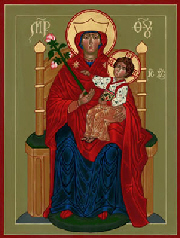
I must admit that I find it a little strange to find an icon of Our Lady of Walsingham. I have seen a few icons depicting western Saints and aspects of western spirituality and have always felt that, somehow, it doesn't quite fit. I suppose this is because I am something of a purist in most walks of life. I believe that each tradition has its riches, but that one element of a tradition, separated from the other elements of that tradition, loses much of its value without the grounding that the whole provides. It needs context in order to be effective.
Icons are not traditional in western expressions of the Faith, and, although I love them dearly (and use one in my own private devotion), I cannot help but feel a little uncomfortable (although that is too strong a word for the sense that I am trying to convey) when I see them used for public veneration in western churches.
Is this a little silly of me? I'd be interested to know what people's thoughts are.