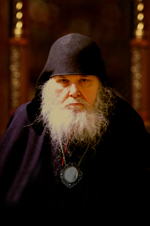
Well, why should I be the only one who doesn't get to use tabloid-style headlines from time to time?
It seem that His Grace Bishop John of Caracas has been charged with the care of Old Ritualist communities in the Russian Church Abroad, which were placed under his extra-diocesan jurisdiction by a decision of the Synod of Bishops on the 13th (26th) of October. Bishop John was elevated to the holy episcopate at the parish of the Nativity, where he was consecrated according to the rites and ceremonies of the Old Rite. He, of course, replaces Bishop Daniel of Erie, who reposed in the Lord earlier this year. This would seem to indicate an ongoing support for the Old Rite and outreach to those who belong to it but who remain separated from the bosom of the Church. Long may it continue.
I am no expert on the Old Rite but only pick up snippets through reading due to my personal interest. However, I have noticed Bishop John's occasionally unusual attire and have always assumed that this was due to his Old Rite consecration. He does not always wear the klobuk, which is a modern combination of the kamilavka and monastic veil, but often the separate veil apparently worn over some form of headwear with a rounded top. Perhaps somebody with more knowledge can add more on this. Notice, as well, the distinctively less ornate Panagia (pectoral icon) and the Russian lestovka instead of the Greek prayer knots that can be seen in the above photograph, taken after Bishop John's consecration. Here are some videos from that occasion:
The Synod seems to be taking a few decisions lately without actually formalising them with a decree. I'm not sure what this means in terms of fluidity and future plans but I find it curious.
New Bishop for Old Rite
Prostrations on Sunday
When I was newly baptised or perhaps still a catechumen, I picked up a great deal of what I know about Orthodoxy from discussions on the internet. Of course, one can question the wisdom of this as it has many pitfalls as well as advantages. Among these snippets of information was the rule that prostrations are forbidden on Sundays, in honour of the Resurrection. I had no reason to doubt this so I simply accepted it, and it was further reinforced by the fact that we did not make prostrations on Sundays at my parish, or at my local Greek or Antiochian parishes which I visit from time to time.So, one Sunday a couple of years ago, when I paid a visit to my local Russian parish and saw some of the faithful prostrate themselves at the epiklesis, my first thought was that perhaps they simply did not know any better. My second thought, having seldom been to a weekday Liturgy, was just how much these people held their Lord in awe and reverence. Really, from that point, I have restrained myself from making prostrations on Sundays, contrary to what my heart calls me to do, and only out of obedience to this "no Sunday prostrations" rule.
Then, just over a fortnight ago, I was at the conference of the Diocese of Sourozh. On the Sunday morning, Archbishop Elisey served the Episcopal Divine Liturgy with his clergy, and I was confused to find that, with the exception of one priest who had trouble with his back, I was the only person in the altar who did not prostrate at the epiklesis.
Not being one to leave any liturgical question unanswered, I did some digging and found statements
Bishop Daniel of Erie Reposes - UPDATED
His Grace Bishop Daniel of Erie reposed in the Lord yesterday, the 13th (26th) of April, 2010, being the feast of the Holy Hieromartyr Artemon of Syria.
Bishop Daniel had been in poor health for some time and our prayers had been particularly asked for him in recent days. A short biography and photo gallery may be found on the website of the Eastern American Diocese. According to the ROCOR Synod website, the funeral is to take place on mid-Pentecost, which is Wednesday of this week. Although details have not yet been finalised, I would be very surprised if the funeral were held anywhere other than the Church of the Nativity, which to all intents and purposes served as Bishop Daniel's cathedral.
Bishop Daniel was ROCOR's extra-territorial bishop for those who belong to the Old Rite, which has been discussed in some small detail on this blog in the past. This was part of the efforts on the part of the Church Abroad to reach out to those who had been so badly treated in the past in order to bring them back into the Church's fold. However, wounds run deep and many of these communities have developed in interesting ways during these centuries of separation, making reconciliation difficult in many cases. As such, only one parish has so far returned within the Church Abroad, (although I gather that others have returned in the Russian Patriarchal Church). ROCOR reaffirmed its support of the Old Rite in the consecration of Bishop John of Caracas in 2008, which was performed according to the Old Rite. However, whether a new bishop will be consecrated to care for our brothers and sisters of the Old Rite remains to be seen.
Bishop Daniel was also sympathetic to the Western Rite, seeing it as simply another equivalent to the Old Rite.
Whatever happens, I am sure that the people of the Church of the Nativity have lost a loving pastor, and I pray that they find some consolation.
In a blessed falling asleep, grant rest, O Lord, to the soul of thy servant the Bishop Daniel, and make his memory to be eternal.
Update: 30/04/2010
Photographs of Bishop Daniel's funeral.
And a video:
Preparation for Communion
For understandable reasons, people are generally quiet about their own devotions. The means whereby people prepare for Communion is a very private affair, best kept among God, the communicant, and the communicant's spiritual father or mother. Because of that, it is very easy to assume that what we do as inidividuals is the norm, without giving it a second thought. I realised a few days ago that I had fallen into the same trap when, on two separate occasions, I was put to shame by two people who innocently made their apologies as they absented themselves to make their particular preparations which made mine appear paltry by comparison. I know that the aim of these devotions and prayers is not to try to appear before God to be holier than another - after all, we know the story of the Publican and the Pharisee - but rather to humble ourselves before our Lord and God. I know that there is no question of contest or anything like that but I know that there are times when I could benefit from more rigorous preparation and I wonder whether I am perhaps too lax sometimes. I have thought about this a little more since a recent exchange on another blog.
I wonder whether I may put upon readers to take part in a poll about your own practice. It is entirely anonymous and if you choose to comment on the post with or without having taken part in the poll, you mustn't feel under any obligation to share the detail of your own practice. However, I think it may be useful for us to see how what we do compares to the custom of others, and to perhaps stir us to question ourselves about whether what we do truly is most beneficial for us. Perhaps, as well, we should remember that some work full time while others do not, some have children while others do not, some drive long distances to get to church while others do not, and that while others may do much more than we do, it may not necessarily be reflective of any lack of desire for Christ in our own hearts.
So here it is. The answers come from the rule of preparation in the Old Rite prayer book, with the exception of the penultimate one, which I think is a monastic practice but which I have heard of being insisted upon by some parish clergy.
Two-Fingered Blessing
Over on the New Liturgical Movement weblog, we have recently been treated to a pictorial discussion of the priestly blessing given with the first two fingers extended. While the subject matter of the post is indeed limited to the use of this form of blessing in the Latin Rite, I feel that the reference to it as "the Latin Gesture of Benediction" is something of a misnomer, as it implies that this gesture is peculiar to the Latin Rite, which is highly inaccurate.
This gesture is readily found in the Byzantine Rite, and indeed was the form of blessing in the Russian Church before the 17th century reforms of Patriarch Nikon, when, among other changes, the Greek ICXC Christogram was imported into Russian practice. To this day, those priests and bishops within the Russian Orthodox Church who are blessed to serve the Old Rite still impart the blessing in this manner, as do those of the Old Believers still not yet restored to communion with the Church since the schism and persecutions.
Writing from the Church of Antioch in the 5th century, St Theodoret of Cyrus has this to say:
This is how to bless someone with your hand and make the sign of the Cross over them. Hold three fingers, (that is, the thumb, ring finger, and little finger), as equals, together, to represent the Trinity: God the Father, God the Son, and God the Holy Ghost. These are not three gods, but one God in Trinity. The names are separate, but the divinity one. The Father was never incarnate; the Son incarnate, but not created; the Holy Ghost neither incarnate nor created, but issued from the Godhead: three in a single divinity. Divinity is one force and has one honour. They receive on obeisance from all creation, both angels and people. Thus the decree for these three fingers.
You should hold the other two fingers slightly bent, not completely straight. This is because these represent the dual nature of Christ, divine and human. God in His divinity, and human in His incarnation, yet perfect in both. The upper finger represents divinity, and the lower humanity; this way salvation goes from the higher finger to the lower. So is the bending of the fingers interpreted, for the worship of Heaven comes down for our salvation. This is how you must cross yourselves and give a blessing, as the holy fathers have commanded.
While I have not been able to find the texts of these, OrthodoxWiki tells us of the homilies of Ss Meletius of Antioch and Peter of Damascus, also writing from within the Patriarchate of Antioch, in which they also affirm the two-fingered making of the Cross as proper. So it seems that this was an early tradition in the Antiochene rites.
Below is a video of part of the consecration of a bishop at the Old Rite Church of the Nativity. It shows a portion of the election and presentation of Hegumen John immediately prior to his consecration as Bishop of Caracas. At 0.26, you can see Bishop Peter of Cleveland blessing in the traditional two-fingered manner.
Not only is this found in practice and in writing, but also the iconographic tradition shows that the ICXC Christogram used in New Rite churches is in fact a late variant practice. Here, for instance, is the famous Pantokrator icon of the Saviour at Holy Transfiguration Monastery, Sinai:
Here also is the equally-famous Pantokrator from Agia Sofia in Constantinople:
Here is the dome icon of the Christ Pantokrator in the Church of the Nativity, (the location of the consecration in the above video):
Below are a number of icons, dating from the 16th century and earlier, all showing this form of blessing as normative in the Byzantine Rite churches up until at least that point.
The Hodigitria icon of the Mother of God:
St Thomas the Apostle:
St Theodore the Studite:
St Nicholas the Wonderworker of Myra:
St Elias the Prophet:
So strong is this form of blessing in the Byzantine Rite consciousness that many newer icons depict Christ and his Saints giving the two-finger blessing, even when the icons are of modern-day Saints who used the New Rite during their earthly lives.
St Nicholas of Japan:
St Raphael of Brooklyn:
St John of Shanghai and San Francisco:
There is even one of St Seraphim of Sarov, who was himself a staunch New Ritualist and firmly opposed to the older tradition*:
All things considered, I think that it's fairly safe to say that any presentation of this manner of blessing as "the Latin gesture of benediction" is a very difficult one to support indeed.
*This is no slight on the great Saint, whom I love dearly. He lived at a time when many people still believed the reasons given for the Nikonian revisions: that the Russian Old Rite was different from the Greek tradition of the time because of illegitimate developments in Russian custom. Due to more recent scholarship and the discovery of manuscripts, it is now widely accepted that the Old Rite in many ways represents an earlier, authentic tradition which fell into disuse elsewhere. Among other things, this has led to the lifting of the anathemas against those who use the Old Rite and an asking of forgivness of the Old Ritualists for the wrongs done to them.
The Old Rite - part two

Christ Pantokrator in the Old Rite Church of the Nativity, Erie
In this second post about the Old Rite, I want to share some of the treasures that I have found, some of which I have incoporated into my own devotions. I should add that I'm not sure I could belong to an Old Rite parish, as there seems to be a degree of strictness in the execution of the services and prayers that I find too regimented for my own spiritual growth. I also think that there were some traditions that did need to be revised, such as the praying of the third, sixth, and ninth hours in sequential order before the Liturgy instead of at their appropriate times. What I do like, though, is that, when there is no Liturgy, the ninth hour has portions of the Liturgy inserted and becomes a form of what is more commonly known as the Typika service.
However, there are also many beautiful traditions, and I actually have a great deal of sympathy with those faithful people who, three hundred years ago, having been formed from birth in their faith and spiritual life by these prayers and services, resisted when they were suddenly told that they would have to stop using them in favour of abbreviated versions. I think that those of us who belong to the New Rite really have lost something in not continuing some of these devotions.
The Old Rite bilingual prayer book
Perhaps the most obvious difference lies in the music. The Old Rite maintains the use of Russian chant before it was unfluenced by the west, so it is much closer to Byzantine and even Gregorian chant than the four-part harmonies that many of us know today. Znamenny chant, in particular, can be very beautiful, and some good examples of it can be heard sung by the choir of the Valaam monastery on their various recordings, and I am pleased that there seems to be increasing interest in its use in New Rite churches. One noticeable feature is that the voices in this style of chant are what we in the west would call "untrained", producing a very nasal sound. However, this is authentic to this style of music. The Old Rite chants for the readings are nice but they are quite sombre. I have taken to using them during fasting periods and at funerals outside of the paschal season. (Otherwise, I use the melodic chants from the Carpatho-Rusyn tradition). Compare the almost monotone deacon's petitions during the litanies in the New Rite to the beautiful melodies used in the petitions in this video from the Old Rite Uspenia monastery, (it is perhaps best not to comment on the doctrinally-questionable icon in the ceiling):
Some interesting differences that I have noticed is that some things that are optional today seem to be just part and parcel of the Liturgy: the tropars on the Beatitudes, psalm 33, and I'm sure there are others. Perhaps this reflects our modern-day penchant for abbreviating. Some of the litanies, hymns, and responses are slightly different as well - usually longer than what we have today.
Another difference is the manner of crossing oneself. We New Ritualists are accustomed to pressing our thumb and first two fingers together, with our ring and little fingers pressed to our palm, and crossing ourselves at each invocation of the Holy Trinity. In the Old Rite, they cross themselves in the way depicted still in most icons where a blessing is imparted. The first two fingers are extended, with the middle finger slightly bent, and the Cross is seen as a symbol of the Christ rather than the Trinity. This is reflected in when the Cross is made during services and prayers.
The lestovka, in common use in Russia before the importation of the chotki from Greece, is still the most common form of prayer aid used by Old Rite Orthodox Christians.
One thing that I have personally adopted is the use of the entrance and departure bows when entering and leaving church. These exist in the New Rite as well, and the Jordanville Prayer Book does give the manner of doing them, but this form is greatly curtailed and, as such, these signs of reverence are often ignored completelely, especially in churches outside of the Rusian tradition. The journey to church can be quite hectic for me and I find it very helpful to walk into church and have these prayers to say before I venerate the icons and greet my brothers and sisters. It helps me to make the transition from the hustle and bustle of public transport to a quiet reverence, and the departure bows help me to retain that as I leave to go back into the world.
There are many, many other differences in the forms of worship and execution of the services, many of which may be read about here, (though not without bias). There are a good few websites out there with a wealth of information on the Old Rite. However, if some of these seem acerbic in tone, please remember the persecution that Old Ritualists have suffered at the hands of New Rite church authorities in the past. I have found it better to find people on the internet and approach them directly. I have found them loving and always willing to explain things to me. Better yet, if you have an Old Rite church near you, (which I don't), why not go and visit?
The Old Rite - part one
I have recently developed something of an interest in the Old Rite. I find it absolutely fascinating, although I do have mixed feelings about it. However, all in all, I am delighted that it is an ongoing part of the life of the Church.
Some of you will be aware of the differences today between Russian and Greek practice. Russian churches tend to do the three antiphons in full while Greek churches usually replace them as standard practice with the much shorter form of a few verses from the psalms interspersed between responses - a form that is properly only used on feasts of the Lord. Russian churches do the epiklesis in full while Greek churches do a much, much shorter form, (the longer form did appear in some earlier Greek manuscripts but has fallen into disuse there now). Ask Greek clergy about the Litany for the Departed at the Liturgy and you will be greeted with blank stares. The Litany for the Catechumens is often omitted, as indeed are most of the litanies between the Gospel and the Cherubikon. When the Augmented Litany is used in Greek churches, it is seldom augmented - the reason it is called the augmented litany is that this is when special petitions are supposed to be inserted for local concerns: the sick and departed of the parish, travellers, expectant mothers, the newly-baptised, and so forth - these are not added in most Greek churches. I have also neither heard Psalm 33 chanted in its place in Greek tradition churches nor have I seen it in the Greek service books.
These omissions and abbreviations in the Greek church, (and other churches that follow the Greek tradition), are much maligned by the Russian clergy - and rightly so, in my opinion. How can we stand there during the cherubikon, singing, 'let us now lay aside all earthly cares, for we are about to receive the King of all', while simultaneously omitting half of the Liturgy so that we can get home to the Sunday roast or the football match on the telly? It obviously makes sense to some people but I am afraid that my little mind simply cannot comprehend it. The Saints before us entered as fully as they could into the prayer of the Church and it seems to have done them no harm.
But continue thou in those things which thou hast learned, and which have been committed to thee: knowing of whom thou hast learned them.
Many - though not all - of these differences are due to a new Greek typikon which was introduced in 1888. It was the revision work of one man rather than a conciliar effort of liturgical scholars and hierarchs of the Church. Yet, it was blessed for use by the Ecumenical Patriarchate and is today most widespread in the Greek parochial (though not the monastic) tradition, although it is still objected to by many Greek clergy, including Metropolitan Kallistos of Diokleia, who has described the changes as "ill-advised" and the new typikon as being "flawed in many places". I should emphasise at this point that my criticism is not of Greek-tradition clergy. They are simply being obedient to the customs that they have been taught and I am sure serve these forms of the services faithfully. It is the customs themselves to which I am objecting.
So why is there such distaste among the Russian-tradition churches for these Greek-tradition practices? The obvious answer is that many of them reflect a will to shorten the services as much as possible. However, I wonder whether there may be something more to it than this. You see, this has happened before, and I suspect that, having before their eyes to this day the lasting effects of the conflict that ensued, the Russian Orthodox people see it as much more prudent to remain faithful to the tradition that they have received, rather than risking stirring up further and unnecessary trouble.
If we were to travel back in time to the 17th century, what we would find would be a situation where the Greek church had simplified and abbreviated its services over time, ridding them of many accretions that clouded the meaning of the services but also of many beneficial elements that aided the participation of the faithful in the Mysteries of the Church. Patriarch Nikon of the Russian church decided that it was time that Russian practice caught up with these changes in Greece. These changes were implemented, and the result is largely what most Orthodox people today are accustomed to experiencing in the churches and regular prayer life - the New Rite. However, these changes did not slip through without considerable oppositon. Some may see a parallel to what happened in the last century in the Roman Catholic church, which would perhaps have done well to learn from the past mistakes of its Orthodox friends. To cut a long story short, those who opposed the changes were anathematised for their disobedience, and have been treated with alternate sympathy and persecution in the intervening centuries. Today, those who remain faithful to the old rite are called Old Ritualists. Sometimes they are referred to as Old Believers but this has often been used as a pejorative term and many consider it offensive.
There has been a significant amount of hurt caused over the years but the anathemas against the Old Ritualists were finally lifted in the 1970s. A number of Old Rite people have returned to the main Russian church and have been permitted to continue using their earlier forms of prayer and worship, and I pray that the poor treatment that they have received in the past may remain a thing of the past, and that this reunification will continue over the coming years.
Bishop Daniel of Erie, ROCOR Old Rite bishop
In order to better facilitate this, in the Russian Orthodox Church Outside Russia, there has been consecrated an Old Rite bishop to care for an extra-territorial diocese of Old Rite communities, wherever they may be, and one of the most recent episcopal consecrations in our church, that of Bishop John of Caracas, was performed according to the Old Rite.
One of the most prominent Old Rite parishes to have returned to the mainstreasm Russian church is the Church of the Nativity, on whose website there is a fair amount of information about Old Rite practices. I hope to post a little about these practices myself in the near future but, in the meanwhile, please explore this site and learn more about our brothers and sisters who remain faithful to the old ways.
Through the prayers of the Mother of God, may the rapprochement continue!